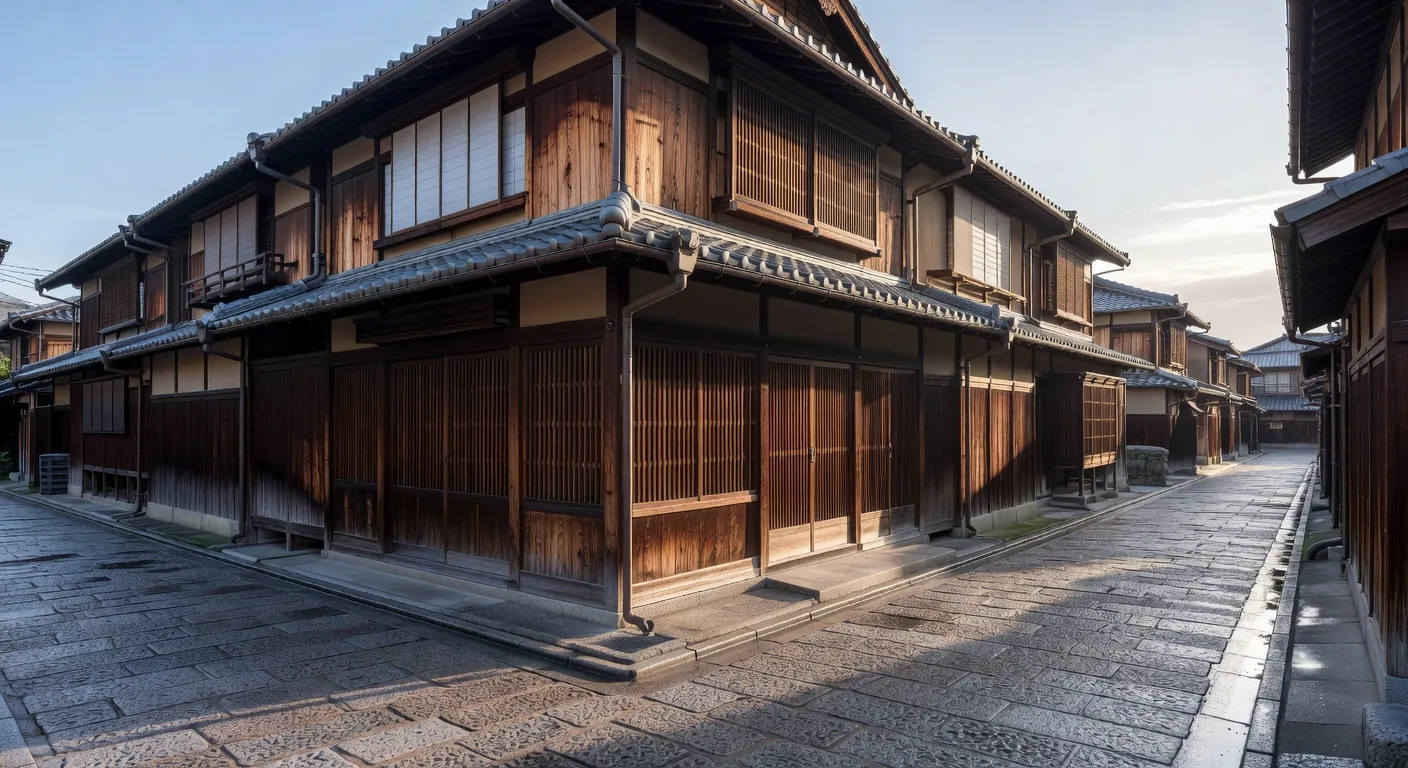
Machiya — Kyoto's Living Heritage

The narrow-fronted townhouses that shaped the soul of Japan's ancient capital.

Introduction to Machiya

The machiya (町家) is one of Japan's most distinctive building types — a timber-framed townhouse that served simultaneously as merchant home, workshop, and shopfront in Japan's historic urban centres, most famously in Kyoto.

Characterised by a narrow street frontage and remarkable depth reaching far into the block — hence the popular nickname unagi no nedoko, "eel's bedding" — the machiya solved the problem of minimising costly street-front property while maximising usable living and commercial space. Some examples extend 30 or even 40 metres back from the street, punctuated by interior gardens that bring light and air deep into the structure.

At their peak in the late Edo period, Kyoto alone contained over fifty thousand machiya. Today, fewer than forty thousand survive, and the rate of demolition — approximately 3% per year — has alarmed preservation advocates since the 1990s.

Anatomy of a Machiya

Every machiya follows a similar organisational logic, progressing from public commerce at the street front to increasingly private domestic space toward the rear.

Rooftop / Ridge
Upper Floor Storage 二階
Shop Front (Mise-no-ma) 見世の間
Living Room (Zashiki) 座敷
Inner Garden (Tsuboniwa) 坪庭
Kitchen (Daidokoro) 台所
Rear Storehouse (Kura)

Schematic cross-section from street to rear — not to scale

  1. 01

    Koshi (Lattice Facade)

    The distinctive wooden lattice screen of the facade allowed merchants to display wares and admit customers while maintaining a visual barrier between street and home.

  2. 02

    Doma (Earth-floor Passage)

    A hard-packed earth corridor runs along one side of the machiya from entrance to kitchen, serving as the functional spine of the building for deliveries and daily work.

  3. 03

    Tsuboniwa (Pocket Garden)

    One or more small interior gardens punctuate the depth of the structure, admitting natural light and ventilation to rooms that would otherwise be entirely interior.

  4. 04

    Zashiki (Reception Room)

    The formal tatami-floored room for receiving important guests, typically located at the rear of the structure overlooking the garden — the most private and refined space.

Historical Context

The machiya tradition evolved gradually from the Heian period onward as Kyoto grew from an imperial capital into a commercial city. By the Muromachi period (1336–1573), the city's merchant class had developed a distinctive urban building type that combined the requirements of trade with those of domestic life.

The great fires that repeatedly swept Kyoto — including the catastrophic Onin War (1467–1477) which reduced much of the city to ash — paradoxically helped standardise the machiya form. Each rebuilding cycle saw faster, more economical construction techniques refined, and a recognisable typological language emerge from the repetition.

"The machiya is not merely a building type. It is a complete philosophy of urban coexistence — commerce and privacy, public and intimate, the individual and the neighbourhood, held in perfect proportion."

The Edo period (1603–1868) saw machiya construction reach its zenith. Kyoto's thriving textile trade, particularly the production of Nishijin silk, funded increasingly elaborate townhouses whose refined interiors belied their modest street frontages — a characteristic described by the Japanese term uchi-naka soto-naka, "plain outside, rich inside."

Famous Machiya Districts

Higashiyama Ward

Kyoto Gion

The historic geisha district retains some of Kyoto's finest machiya, including the distinctive okiya (geisha houses) and teahouses of Hanamikoji Street. The narrow lanes and preserved facades make Gion the most photographed machiya district in Japan.

Nakagyo Ward

Nishiki Market Area

The blocks surrounding Nishiki — Kyoto's "kitchen" — contain some of the city's oldest surviving commercial machiya, many still operating as food shops and restaurants in their original structures. The area demonstrates the remarkable continuity of machiya as working commercial buildings.

Higashiyama Ward

Higashiyama Sannen-zaka

The stone-paved lanes climbing toward Kiyomizudera temple are lined with well-preserved machiya, some dating to the early Meiji period. Here the townhouse typology adapts to the steep terrain of the eastern hills, creating a visual layering unique to the area.

Restored Kyoto machiya facade

Restoration Spotlight

The machiya at Nishi-no-toin Shijo, restored in 2019 by the Kyoto Machiya Revival Fund, represents one of the most technically challenging restoration projects undertaken in recent years. The structure, dating to the 1880s, had been partially modified in the 1960s with concrete block infill and metal-frame windows.

Over eighteen months, a team of eight specialist carpenters worked to reverse the mid-century modifications, source period-matched materials, and stabilise the original timber frame. The project documented every stage photographically, creating a restoration methodology now used as a teaching resource.

The restored machiya now operates as a small boutique inn, demonstrating that thoughtful adaptive reuse can sustain these structures economically while preserving their architectural integrity.

Read Full Case Study

Architectural Elements

Facade Design +

The machiya facade is composed of a delicate lattice screen (koshi) of vertical cedar strips whose spacing and pattern varied by the merchant's trade — a code readable to contemporaries. Above the lattice, a low second-floor window called the mushiko-mado (insect cage window) provides ventilation while maintaining privacy.

The overhanging eave (noki) projects well beyond the facade to protect the timber lattice from rain and direct sun, creating the characteristic shadowed lower storey that characterises the Kyoto streetscape.

Interior Layout +

The interior unfolds as a sequence of distinct zones from public to private. The mise-no-ma (shop space) at the front transitions through a wooden step into the tatami-floored living areas. The earthen-floor doma corridor running along one side provides a parallel functional spine for kitchen work and deliveries.

Rooms are defined by sliding screens (fusuma and shoji) rather than fixed walls, enabling the interior to be reconfigured for different uses — entertaining, ceremonies, seasonal celebrations — with remarkable flexibility.

Roof Design +

Urban machiya typically used fired clay pantiles (hongawara-buki) rather than thatch — a practical response to the fire risk inherent in densely built townscapes. The tiles sit on a complex arrangement of sub-battens and waterproofing boards, with careful detailing at ridges and valleys to prevent the ingress of Kyoto's heavy summer rains.

The characteristic ogee-curved roofline of Kyoto machiya — the result of the tile profile and the slight upward kick at the eave ends — is immediately recognisable and quite distinct from rooflines in other Japanese cities.

Materials +

Traditional machiya construction used Japanese cypress (hinoki) for principal structural members, cedar (sugi) for the lattice facade and interior panelling, and bamboo as a plaster reinforcement within the earthen wall panels (tsuchikabe). Floors were finished with tatami over a timber sub-floor, or left as compacted earth in the work areas.

The distinctive dark finish of many machiya exteriors — achieved with persimmon tannin (kakishibu) or pine-tar preservatives — served both as weather protection and as a practical barrier against insects, while developing the characteristic patina that defines the aesthetic of these buildings.

Cultural Significance

Urban Fabric

The machiya is the fundamental unit of Kyoto's historic urban fabric. Streets of continuous machiya create a rhythm and texture that gives the city its identity — an identity recognised by UNESCO and countless visitors who find something irreplaceable in these lanes.

Craft Knowledge

Building and maintaining a machiya demands specialised craft knowledge — from the joinery techniques of the timber frame to the mixing of earthen plaster walls. Each surviving machiya is a repository of this knowledge, and each skilled carpenter who works on them is a living link to the tradition.

Community Life

The machiya is inseparable from the Kyoto neighbourhood (cho) system — the micro-community of a single city block that collectively organised festivals, fire prevention, and mutual aid for centuries. These social structures survived precisely because the architecture supported them.